The serum-class member of the NanoBase™ family. A fluid, fully modular tri-domain nano-colloidal architecture engineered at ~185 nm and held by engineered interfacial charge rather than by surfactant HLB balancing. You build your finished serum on top of it with room-temperature mixing — no nano equipment, no added water, no added surfactant.
Griffin HLB systems hold an emulsion by balancing surfactant affinity. Classic holds it electrostatically: a multi-component anionic interfacial wall establishes mutual repulsion between droplets, so stability comes from the interface itself rather than from a ratio that has to keep holding. A charge-independent steric brush is added last, sits outermost, sets droplet size during processing and gives the system tolerance to cationic material added downstream.
Structural lipid dispersion. Carries the lipophilic load and receives the oil you add downstream.
Phospholipid bilayer organisation. This is where peptide and hydrophilic payload is absorbed and held.
Added cold, last. The compatibility buffer that sweeps free lipophile and keeps the architecture tolerant of what you add.
Bench characterisation on the current Classic architecture held the distribution to within instrument noise across a full 24-hour window that included a cold addition, a refrigerated hold and a rewarm to room temperature — no ripening, no coalescence, no detectable thermal-cycle damage in the primary mode.
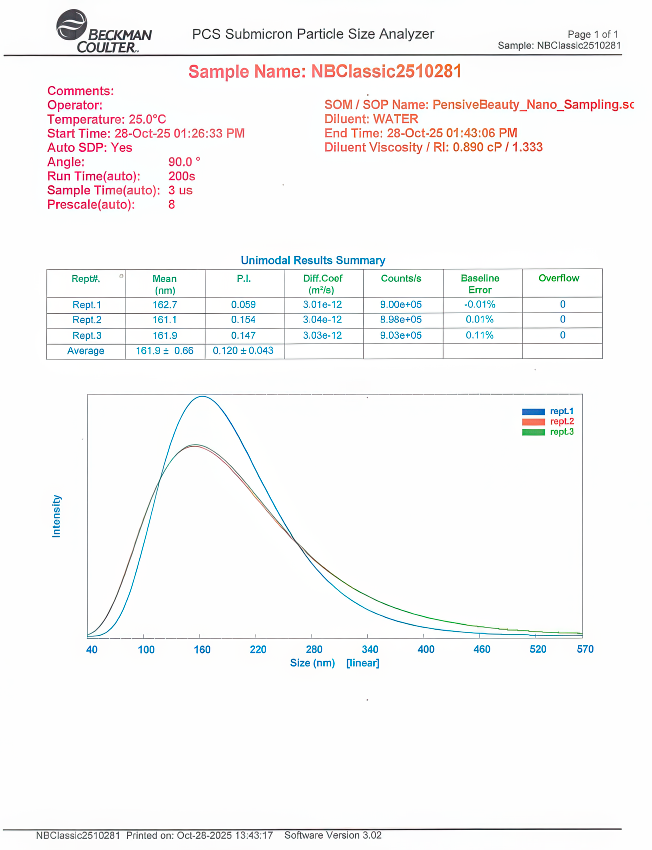
Every batch is characterised by Dynamic Light Scattering before release. Distribution is read across multiple angles rather than reported as a single number, because a single cumulant hides the tail that actually governs shelf life.
Characterisation is performed under controlled production conditions. Figures describe the engineered architecture itself; finished-product performance depends on the formula built on top of it.
NanoBase™ is engineered to a platform target of ~185 nm, and every batch is then characterised individually by Dynamic Light Scattering before release. Below is an actual analyser record from a Classic batch — the raw instrument output, not a redrawn chart.
Individual repeats: 162.7 / 161.1 / 161.9 nm. A polydispersity index below 0.20 indicates a narrow, well-controlled distribution; below 0.10 is generally treated as monodisperse. Batches are released on their own record rather than on the platform target. Full batch documentation is available under NDA for qualified development programmes.
The architecture is built in our lab. Your job downstream — or your contract manufacturer’s — is only to partition your actives into the domains the architecture has already made.
Classic goes in at roughly 85% of your finished serum. The water phase is built in, so there is never a need to add water.
Peptides, humectants, antioxidants, botanical extracts, up to about 12% peptide and 5% oil. Room temperature, gentle mixing.
The mixing does not emulsify anything. It distributes what you added into the nanoemulsion, liposomal and micellar domains already present.
Confirm pH sits at or above 5.7, then fill. No heating, no high shear, no specialist equipment anywhere in the process.
Because the architecture is fully modular and arrives already built, your CM never has to make it. There is no nano equipment to buy, no sonication step, no tech transfer and no specialist training — the entire downstream process is gentle room-temperature mixing with the equipment every contract manufacturer already owns. Bring us your existing CM, or we will introduce you to one. You own the formula and the SDS either way.
High active loads carried without the usual compatibility fight.
Short ingredient decks where the architecture does the work.
Serum feel with more body, without moving to a cream architecture.
Humectant-forward systems with peptides held in the liposomal domain.
Charge-mapped so cationic peptides do not collapse the wall.
Non-ionic preservation compatible with clean retailer standards.
Tell us what the product has to do. We will show you what it looks like engineered on Classic.